
文献阅读 TINYBERT DISTILLING BERT FOR NATURAL LANGUAGE UNDERSTANDING
1 Introduction
[1] TINYBERT: DISTILLING BERT FOR NATURAL LANGUAGE UNDERSTANDING Link : http://arxiv.org/abs/1909.10351 Institute:Huazhong University of Science and Technology, Huawei Noah’s Ark Lab, Huawei Technologies Co., Ltd. Code : https://github.com/huawei-noah/Pretrained-Language-Model/tree/master/TinyBERT
1.1 Achievement
- Propose a novel Transformer distillation method
- Introduce a new two-stage learning framework.
- Achieve 96% the performance of BERT_BASE while being 7.5x smaller and 9.4x faster on inference.
2 Method
2.1 Transformer Distillation
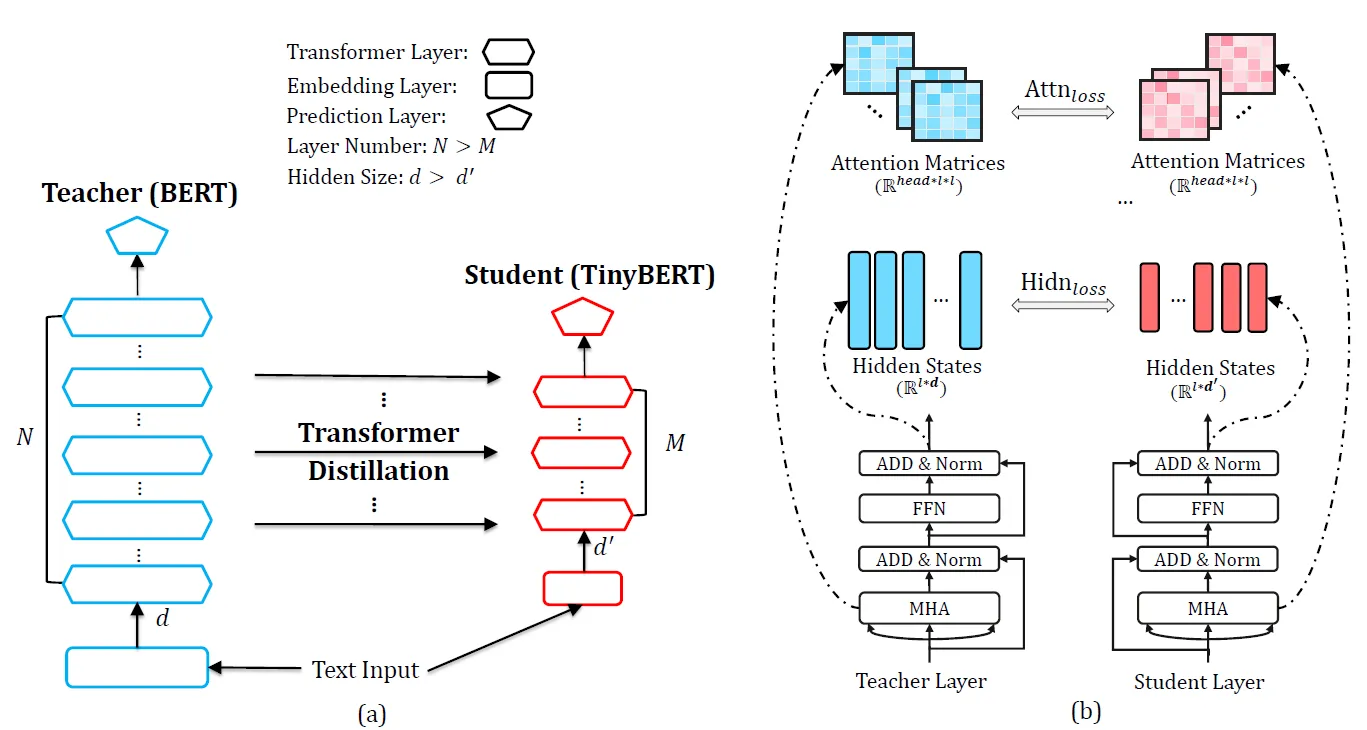
Figure 2.1: An overview of Transformer distillation[1]
Problem : Original BERT is too big and need too much time for training.
Requirement : Reduce the scale of BERT while maintaining almost the same performance.
Solution : (Teacher-Student Framework)
- Choose M layers (Layer Num. of Student Model) from N layers of the Teacher Model for Transformer-layer distillation
- Use n = g(m) to denote the mapping function
- For embedding-layer distillation and prediction layer distillation, the corresponding layer mappings are denoted as 0 = g(0) and N + 1 = g(M + 1).
- Loss Function:
* Where lambda_m is the hyper-parameter represents the importance of the m-th layer distillation, L_layer( ) is the loss function of a given layer pair. * This formula calculate the total loss of every layer ranged from 0 to M+1.
2.1.1 Transformer-layer Distillation
- Use attention-based distillation to learn the matrices of multi-head attention in the teacher network
- Attention-based Loss Function:
* Where h is the number of attention heads, A_i(l*l) is the attention matrix of the i-th head, l is the length of the input text, MSE( ) is the mean square error function. * It shows that A_i without softmax has a faster convergence rate and better performance. 3. Use hidden states based distillation to learn the feature of hidden states in the teacher network * I think this part actually enable the student model to learn the feature of FNN in teacher model. 4. Hidden States based Loss Function:
* Where H^S (l*d’) and H^T (l*d) refer to the hidden states of student and teacher, W_h(d’*d) is a learnable linear transformation mapping student network into the vector space of teacher network, d’ and d refer to the hidden sizes of student and teacher network (Usually d’ < d) .
2.1.2 Embedding-layer Distillation
- Use learnable matrix W_e to map student model into the vector space of teacher model
- Embedding-based Loss Function:
* Where E_S and E_T refer to the embedding matrix of student and teacher model, W_e is the learnable linear transformation.
2.1.3 Prediction-Layer Distillation
- Use soft cross-entropy loss:
* Where z^T and z^S refer to the logits vector output by teacher and student model, t is the temperature value. * In the experiment, they find t = 1 performs well.
2.1.4 Final Distillation Objective Function
2.2 TinyBERT Learning
They apply a two-stage learning framework:
- General Distillation: Help TinyBERT learn rich knowledge embedding and improve the generaliztion capability of TinyBERT
- Task-specific Distillation: Use specified task to enable TinyBERT to learn task-specific knowledge
2.2.1 General Distillation
- Use the original BERT without fine-tuning as the teacher and a large-scale text corpus of general domain as the training data
- Perform the above mentioned transformer distillation to obtain a general TinyBERT which may have worse performance than BERT
2.2.2 Task-specific Distillation
- Use fine-tuned BERT as the teacher and a domain-specific dataset as the training data
- Perform transformer distillation on the TinyBERT after general distillation
2.2.3 Discussion about Two-stage Learning Framework
The above two learning stages are complementary to each other: 1. The general distillation provides a good initialization for the task-specific distillation. 2. The task-specific distillation further improves TinyBERT by focusing on learning the task-specific knowledge. 3. Finally, although there is a big gap between BERT and TinyBERT in model size, by performing the proposed two-stage distillation, the TinyBERT can achieve competitive performances in various NLP tasks. * From the original paper
3 Experiment Result
Table 3.1: Results of GLUE official benchmark[1]

Table 3.2 The model sizes and inference time for baselines and TinyBERT[1]

The experiment results demonstrate that: 1. There is a large performance gap between BERT_SMALL and BERT_BASE due to the big reduction in model size. 2. TinyBERT is consistently better than BERT_SMALL in all the GLUE tasks and achieves a large improvement of 6.3% on average. This indicates that the proposed KD learning framework can effectively improve the performances of small models regardless of downstream tasks. 3. TinyBERT significantly outperforms the state-of-the-art KD baselines (i.e., BERT-PKD and DistillBERT) by a margin of at least 3.9%, even with only 28% parameters and 31% inference time of baselines. 4. Compared with the teacher BERT_BASE, TinyBERT is 7.5x smaller and 9.4x faster in the model efficiency, while maintaining competitive performances.
* From the original paper
4 Conclusion
- Introduce a new KD(Knowledge Distillation) method for transformer-based distillation
- Propose a two-stage framework for TinyBERT learning
- Achieves competitive performance while reducing the model size and the inference time